
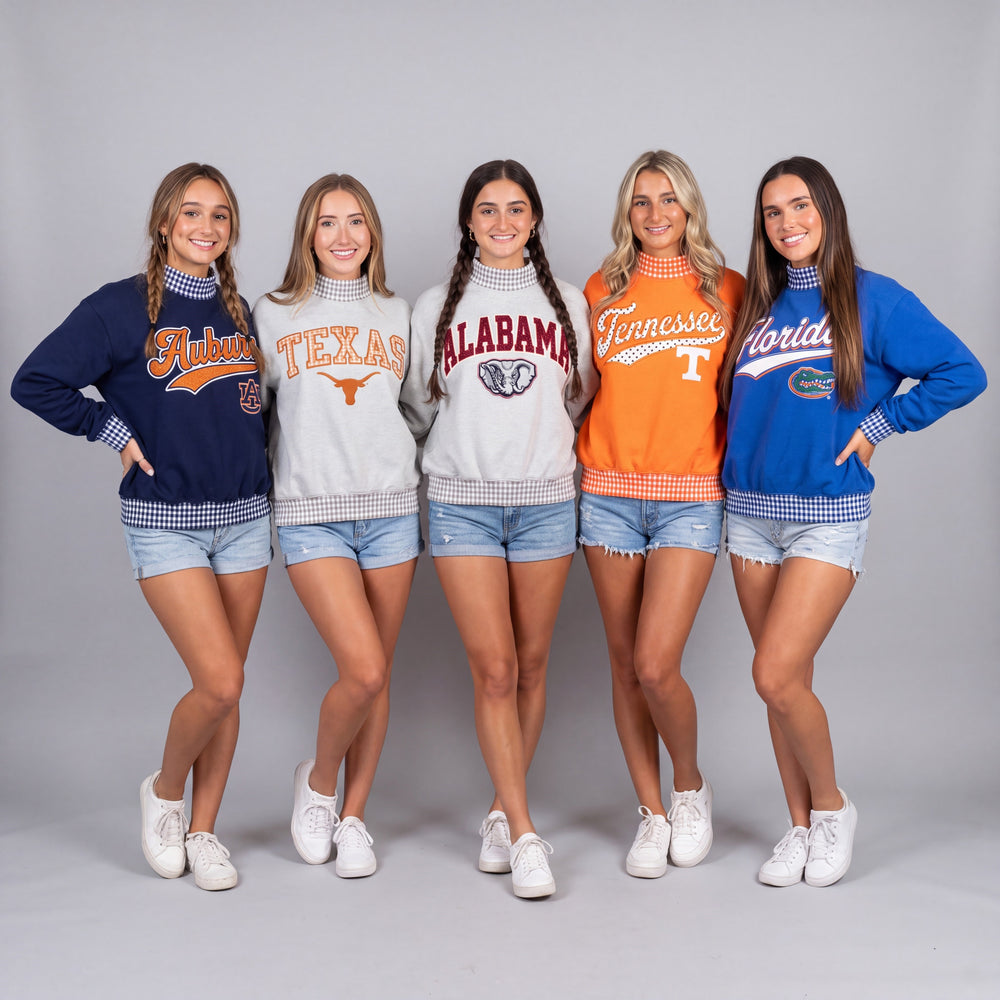






Stitched vs. Printed: Why Appliqué Team Sweatshirts Outlast the Big-Box Kind
Flip over most team sweatshirts from a stadium shop and you'll feel it: a smooth plastic film sitting on top of the fleece. That's heat-transfer vinyl or screen print. It's fast, cheap and looks fine for a season. Then it cracks along the fold lines, fades in the wash and starts to peel at the corners.
What appliqué actually is
Appliqué is fabric on fabric. The team wordmark, mascot and your number are cut from separate pieces of cloth — twill, felt, gingham — layered on the sweatshirt, and then stitched down around every edge. Nothing is glued or pressed. Because the graphic is cloth, it moves and washes like the rest of the garment instead of fighting it.
How to tell the difference in five seconds
- Touch it. Appliqué has a raised, textured edge you can feel. Print is flat and slightly slick.
- Turn it inside out. Appliqué shows a line of stitches tracing the shape. Print shows nothing.
- Fold it. Print creases and whitens along the fold. Appliqué doesn't care.
Why we don't print at all
Every CheckNCheer piece is cut, layered and stitched to order. It takes 5–7 business days instead of five minutes, and it's why we can put your name and number on the back the same way the team crest goes on the front — as cloth, sewn down, built to be washed a hundred times.
How to wash appliqué so it lasts
Turn the sweatshirt inside out, wash cold on gentle, tumble dry low or lay flat. Don't bleach, and don't run an iron directly over the appliqué — the fabric is fine, but the thread doesn't love direct heat. That's it. Treated this way, the stitching outlives the sweatshirt.
See the difference up close on any team page — tap the hotspots on the detail photo to zoom into the collar, the cuffs and the stitched numbers.